Synopsis of the Proceedings of the International Colloquium on “The African Perspective of Benedict XVIi’s Thought” held at the
Catholic University of Central Africa, Yaounde – Cameroon
27th -29th November 2019
By Fr. Herbert Niba,
John Paul II Major Seminary, Mamfe Cameroon
Introduction
From Wednesday 27th to Friday 29th November 2019, the Catholic University of Central Africa played host to an international colloquium entitled “African Perspective of Benedict XVI’s Thought.” This international colloquium was organized to mark the 10th anniversary of the visit of Pope Benedict to Cameroon, an event which took place from 18th to 20th of March 2009.
This conference was organized jointly by the Catholic University of Central Africa, and the Benedict XVI Institute for Africa, which had just organized a similar conference for African Scholars from North America and Europe in the month of October 2019 at the University of Notre Dame, USA.
In the three days of deep exchange scholars, researchers and Pastors from Cameroon and abroad engaged in an interdisciplinary reflection on the visit, writings, and pastoral solicitude of Pope Emeritus Benedict XVI, and the reception of these by the African Church and society.
Day One: Opening Ceremony, Wednesday 27th November, 2019
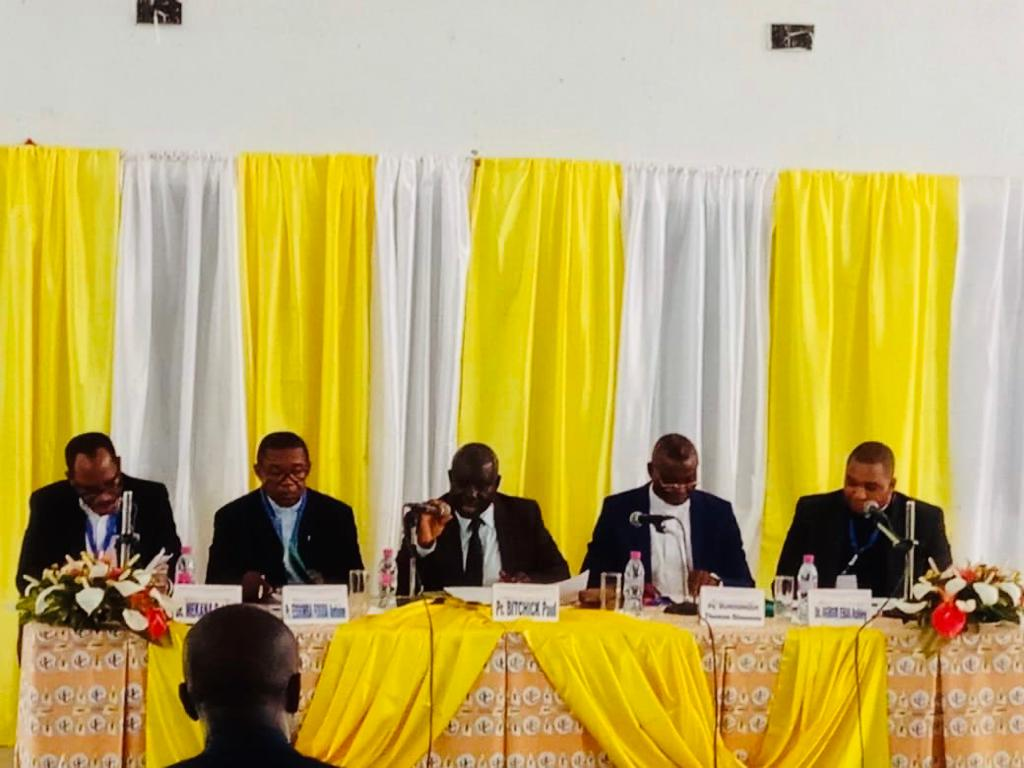
Three main events characterized the opening ceremony. First, there was an Opening Prayer, in which the light of the Holy Spirit was invoked for the smooth flow of the Conference. This was followed by a series of brief speeches, the starting with a word of welcome presented on behalf of the Rector of UCAC (who was unavoidably absent) by Mr. Ettiene Manga, Administrative Secretary General of the same university. He recalled the memorable stay of Pope Benedict XVI in Cameroon, and appreciated the interdisciplinary study of the pastoral solicitude of Pope Benedict XVI towards Africa, which the Pope had often described as “the beloved land of Christ” and his “new homeland”. While thanking all the stakeholders involved in the organization of the conference, he wished all the participants a pleasant stay and fruitful exchange. After this came a word from the representative of the Benedict XVI Institute for Africa, Fr. Maurice-Agbaw Ebai, from Boston College, USA who situated the Conference within the framework of the international initiatives targeting the furtherance of the legacy of Pope Benedict XVI, a discussion in which the Church in Africa had been somewhat absent.
The next key point was the presentation of the Structure of the Colloquium, by Fr. Stephen Kizito Forbi SJ, on behalf of the Scientific Committee that prepared the event. Beginning with a brief spotlight on the person and work of Joseph Ratzinger/Benedict XVI, Fr. Forbi showed the Pope to be a Theologian within his own right, with over 30 publications to his credit before his assumption of the Petrine office. As a key participant in the Second Vatican Ecumenical Council, Joseph Ratzinger ensured its right interpretation by co-founding the Theological Journal Communio alongside Hans Urs Von Balthazar and Henri De Lubac. Ratzinger’s constant return to the Fathers of the Church, revealed the ecclesial vocation of the Theologian, who must expound the timeless truths about God, man and the world in fidelity to Scripture, in communion with the Magisterium and in continuity with Tradition. Benedict XVI was not just a teacher of the faith; he was first of all a believer, who embodied a personal holiness that showed his belief that true Theology must be done “on one’s knees”. After this presentation, Fr. Forbi outlined the four main themes that would constitute the African reading of the thought of Pope Benedict XVI. These were the Theological, the Canonical, Philosophical, and the Social Science/Social panels. He ended his presentation with a message of support and blessing from the office of the Apostolic Nuntio to Cameroon and Equatorial Guinea, Mgr. Julio Murat. On this note he declared the Conference officially opened, and invited everyone to family photo to mark the opening ceremony.
The third event for the opening session was the keynote address, presented by Fr. Charles Moukala, entitled “Benedict XVI and Africa: Hope as a utopic model”. The speaker situated the message of Pope Benedict XVI to the Church in Africa as rooted in hope, a theological Virtue alongside Faith and Love, which the Pope had made the object of his encyclicals. Using the Biblical models of Abraham and also St. Joseph, who had “hoped against all hope”, Benedict XVI was convinced that Africa was a “spiritual lung” and a blessing for the Church. Hope is not just some rhetoric or appeal to resignation, but an invitation to plunge oneself into the Gospel which changes life. Fr. Moukala went on to dissect a threefold hermeneutic of hope that could be discerned from the writings of Pope Benedict XVI. The spiritual-Theological dimension of hope consists in the fact that the Gospel does not directly target the transformation of political structures, but rather the change of human hearts, for Jesus Christ, is not a social revolutionary like Spartacus or Barabbas, but the Chief shepherd of our souls. The ecclesial-communal dimension of hope consists in the fact that hope is not individualistic, nor can it be equated to the Enlightenment’s notion of Progress by Kant or Marx. Mere scientific progress cannot redeem man, for man is not a mere product of economic factors. The third dimension of hope is eschatological, for Christian hope does not have its ultimate goal in an earthly reality, but in making men and women “citizens of heaven”. However, this theology of hope is radically different from the utopia of contemporary thinkers like Ernst Bloch and Jorgen Moltmann. Christian hope, in preparing us for eternity does not ignore the need for Christian involvement in creating a more just social order, and uprooting the structures of sin that thwart the harmony of that order.
The keynote address was an appetite wetter, and provoked a lively exchange of remarks and questions, some of which were answered, and others deferred for the next days conferences.
Day Two: Thursday, 28th November 2019
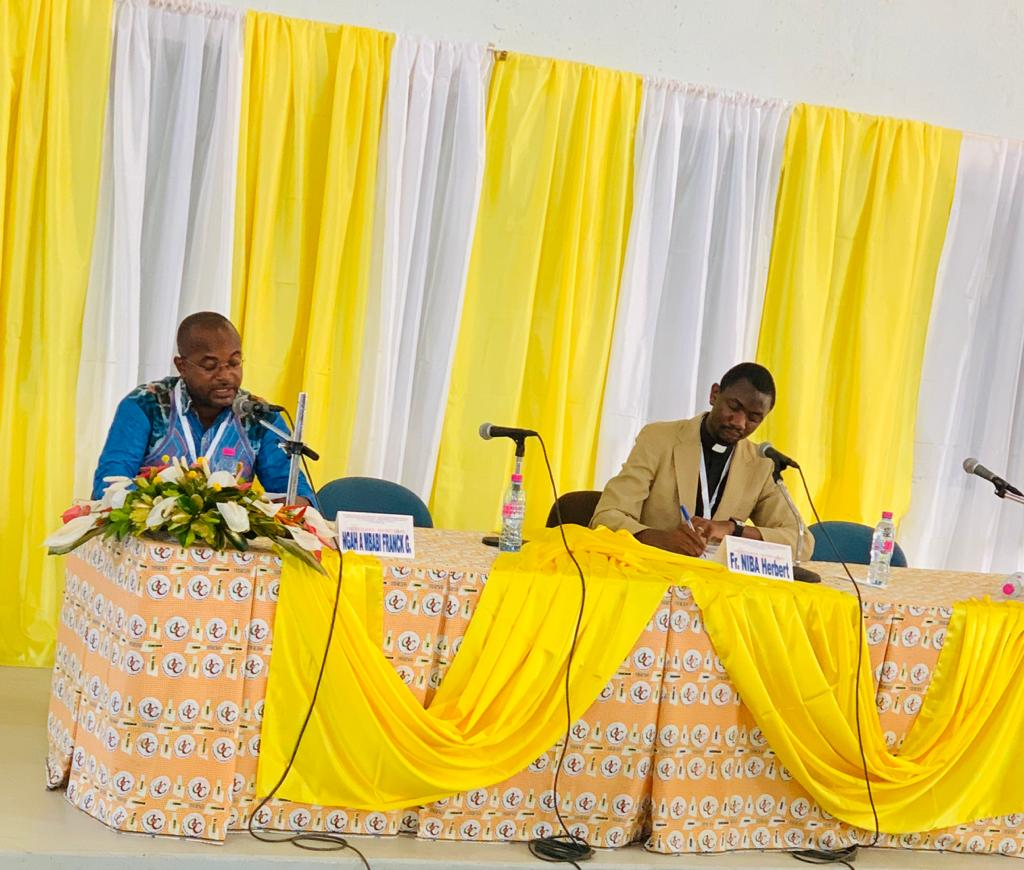
This day featured two panels, the Theology panel in the morning and the Philosophy Panel in the afternoon. The morning session started at 9:10am, with three theological conferences, moderated by Prf Paul Bitchick.
The first Conference, presented by Dr. Antoine Essomba, was entitled: “Benedict XVI’s vision of liturgical reform vis-à-vis the Challenge of Inculturation in the Church in Africa”. The author noted that Benedict XVI championed the right interpretation of Vatican II, and thus insisted on a hermeneutic of continuity in liturgical reform. The liturgy is at the heart of the Church’s life, because the Church in its foundation is an “ek-klesia”, that is, a community gathered in worship. For Benedict XVI then, the “ars celebrandi” or art of celebrating should foster the sense of mystery, and reverence towards what Christ, the principal actor in the Liturgy is doing, and in which we called to participate. Benedict’s vision of liturgical reform, thus lays accent on the equal reverence to the Table of the Word and the Table of the Sacraments, a reinstating the place of silence, rediscovering the inner meaning of acts of piety, and a proper implementation of liturgical norms laid out in Sacrosanctum Concilium. The author noted that although Inculturation is a priority in our local Church, it should not lead to a disintegration of the Church’s liturgy. He cautioned against the introduction of profanity in liturgical celebrations, especially during weddings, funerals and the choice of songs during Mass. For liturgy to transform, it must touch the lives of Christians, giving them reasons to hope, to love and to believe.
The Second conference was entitled: “The Place of Africa in the Social Teaching of Benedict XVI” and was given by Dr. Thomas Bienvenu Tchoungui. The author noted that the approach of Pope Benedict XVI with Africa was shaped by previous decisive encounters with the African Church. First as a peritus at the Second Vatican Council, he interacted with the African prelates present. Secondly, during his supervision of Barthelemy Adoukounou’s doctoral thesis, on “An Essay on Christian Hermeneutics of Dahomian Vodun”, he was introduced to the future debates on inculturation, a theme he would later discuss as Prefect of the Congregation for the Doctrine of Faith in the 21 June 1987 Meeting with African prelates in Kinshasa, DR Congo. Benedict XVI’s social doctrine makes his thought further relevant to Africa because of his handling of themes like charity as a primordial commandment for Christian living, the preferential option for the poor, the duty to justice, ecological challenges, the rightful use of public goods, human rights, and other themes as treated in the encyclical Caritas in Veritate. The author ended by employing the figure of Simon of Cyrene, to argue for hospitality and a Theology of the Cross, as the model for interpersonal relations in African Society and the Church.
The Third Conference was entitled “Joseph Ratzinger and the Universality of Logos in Cultures: The Preference for Inter-Culturality over Inculturation” and was given by Dr. Maurice Agbaw-Ebai. The author’s point of departure was Pope Benedict XVI’s September 12, 2006 lecture at the University of Regensburg, Germany. The leitmotiv of that lecture could be captured from the assertion: “Not to act in accordance with reason is contrary to the nature of God.” For the Greeks, logos was an impersonal force that animated the cosmos, just as the soul animated the body. But for the Fathers, the Logos is a person, the Word of God through whom the world was made, and who became flesh. Using three pre-pontifical texts of Benedict XVI, the author showed Ratzinger’s preference of “inter-culturality” over “inculturation”. By becoming flesh and dwelling among us, the Son of God dignified human cultures. Jesus Christ as the Logos, makes it possible to speak of inter-culturality, because Christ sustains all cultures, and makes them open to the transformative power of the truth. Inculturation on the other hand, presumes an already designed line of action, between an antecedent culture and a receiving one. Ratzinger therefore opens up new roads of thinking, and so African Theology needs not attempt to have a de-hellenized theological orientation for the 21st century. This is captured in Benedict’s call for the re-opening of Origen’s Catechetical School of Alexandria, albeit in a different model.
After this talk, there was a question and answer session that lasted till 12:30pm. Before the lunch break, there was a moment of silence for the repose of the soul of Fr. Christian Mofor, former Rector of the Catholic University of Central Africa.
The afternoon session brought together three philosophy speakers, and the panel was directed by Prf. Brossala Diddy Kondjo.
The first Paper was delivered by Fr. Fabrice Nsemi, entitled “Love and Truth in the Thought of Ratzinger/Benedict XVI”. In tackling the twin concepts of love, the author made recourse to Ratzinger’s dependence upon Augustine, who was the first patristic thinker to develop a Christian theory of love. At the same time, he noted that Pope Benedict avoided the constant opposition between agape and eros, by showing in the encyclical Deus Caritas Est that even God loves with eros. Eros thus needs to be disciplined and purified, so that it can rise above mere carnality to its divine potential. A key starting point for the purification of love, is at the level of language, for love is one of the most used, misused and misunderstood concepts. For the author, truth is practically a leitmotiv for Benedict XVI, who since his Episcopal ordination chose for his motto: “Coworker in the truth”. His papacy was a long defense of truth against the dictatorship of relativism. Fusing the two concepts, then, the author concluded by saying Pope Benedict XVI calls us to love one another in the truth of each other’s being, for deprived of truth, love becomes mere sentiment.
The Second paper, entitled “The Defense of Reason in Benedict XVI”, was delivered by Prf. Gabriel Ndinga. In it the author showed that Benedict XVI’s defense of reason avoids two dangers, first, the absolute and self-sufficient reason of thinkers of German Idealism, such as Kant and Hegel. It also avoids the skepticism of postmodern thought, which has lost faith in the power of reason to discern truth. Reason, for Benedict is ordered to and capable of finding truth. The university milieu is thus a laboratory in the service (diakonia) of truth. As a result, it must be characterized by objective research and the transmission of knowledge. Using examples of Ratzinger’s exchanges with Jurgen Habermas, the author concludes that there is need for a dialogue of intellectuals, of cultures and sciences in the search of the truth. The true man of science, shaped by a right philosophical mind, should be able to rise to the realm of faith, which opens human reason more fully to the Truth found in God.
The Third paper, delivered by Prf. Stephen Kizito Forbi, was captioned “Benedict XVI and the Philosophy of Hope: From Africa the forgotten to Africa of Authentic Hope”. The author evoked the contemporary debate also tackled in Benedict XVI’s Africae Munus, on whether Africa is a cursed continent or a continent of hope. From one standpoint, the socio-political landscape of Africa is marked by multiple coup d’etats, inter-tribal conflicts, and fragile political institutions. To this could be added a certain anthropological crisis, marked by a spirit of mediocrity, the memory of historical wounds, extreme poverty, sickness and new forms of slavery. But Africa is not only bad news, For Africae Munus sees in Africa a continent of hope, and challenges the faithful more than seven times to “rise up” and “march toward” the future. This hope is not mere utopia, but has its basis in the rich intellectual and cultural heritage of Africa. This is what for the Pope makes Africa a spiritual lung for humanity. The new African man, therefore, is a man rooted in the justice of love, reconciliation and peace.
The afternoon session ended with a question and answer exchange that lasted till 4.30pm, before the participants retired for the day.
Day Three: Friday, 29th November 2019
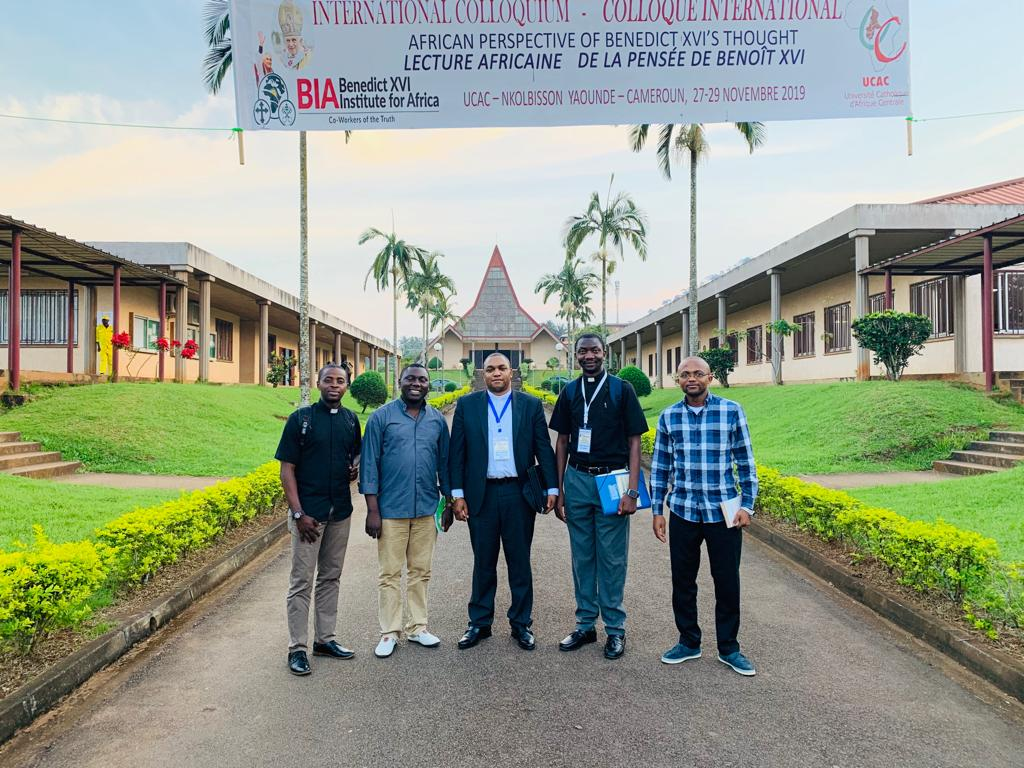
Two panels comprised this day: Canon Law and Social Teaching of the Church. The Canon Law panel, moderated by Prf. Claude Kiamba sought to examine the canonical reforms made during the Pontificate of Pope Benedict XVI.
In the first presentation, “Benedict XVI and the question of Sexual abuse of minors committed by clergy” Prf. Jean-Marie Signe noted that the papacy of Pope Benedict XVI was marked by the unveiling of scandals of sexual abuse of minors by clerics, even if some of these offences were perpetrated long before. As prefect of the Congregation of the Doctrine of the Faith, the then Cardinal Joseph Ratzinger was already charged with the implementation of the measures put in place by Sacramentorum Sanctitatis promulgated by Pope John Paul II in the wake of the 2001 sex abuse scandals. This experience would be further bear fruit in the reforms the Cardinal will later make as Pope. Faced with the lack of necessary structures and qualified personnel in many African Dioceses to handle technical canonical procedures of inquiries and proceedings, the Pope gave a concession to the Congregation for the Evangelization of peoples to handle directly cases coming from these local churches.
Other reforms include Pope Benedict XVI’s revision of Sacrementorum Sanctitatis (2010). In this, for example, he assimilated to the definition of“minor” even vulnerable majors or those who lacked habitual use of reason, while also adding to the definition of “abuse”, the actions of possession of and dissemination of child pornography. He also increased the span of inquiry to twenty years, and made provision for the forwarding of extreme cases to the Pope for dismissal from the clerical state. For Prf. Signe, the message in Pope Benedict XVI’s letter of solidarity to the Church in Ireland speaks clearly to Africa, because the enhancing factors of sexual abuse of minors by clergy are also prevalent here: namely, inadequate scrutiny of candidates for clerical and religious formation, insufficient human and spiritual formation that aims at affective maturity, the tendency of defending clergy and religious, under the guise of soiling the Church’s image. In sum, the message for Africa, from Benedict XVI’s magisterium is that: sexual abuse is not only a canonical delit, but a crime punishable by civil law; it is an antiwitness to the Gospel, and weakens the faith of the people of God. Therefore the Church, in solidarity to victims should ensure not just their healing, but work to prevent future abuse cases.
The Second intervention presented by Prf. Jean Paul Betengue, was entitled “The Preparation for Priesthood in the Legislative Reform of Pope Benedict XVI”. In continuity with the first presentation, this paper situated Pope Benedict’s measures to curb sexual abuse by clerics, by paying attention to norms regarding priestly formation. The first point of note was the transfer of the supervision of seminaries from the Congregation for Catholic Education to the Congregation for Clergy. This move highlighted the distinction (but not opposition) of Catholic Education, which is destined for all persons without distinction of status or category; and priestly formation, which prepares pastors of souls. The next reform was the revision of the philosophical studies, which was aimed at making future priests capable of proposing a reasonable ministerial accompaniment that is pertinent both intellectually and pastoral adapted to today’s world. Pope Benedict XVI saw the priest as an agent of the New Evangelization, which he was convinced was the most pertinent response to our age of secularism, characterized by an “eclipse” of God. Key pontifical acts show Benedict XVI’s commitment to this ideal, in continuity with his predecessor: First, the creation of a Pontifical Council for the Promotion of the New Evangelization in 2010. The next was the convocation in October 2012, of an Ordinary Assembly of the Synod of Bishops on The New Evangelization for the Transmission of the Christian Faith. These, put together with the Year of the Priesthood celebrated in 2009 under the patronage of St. John Mary Vianney showed clearly the Pope’s conviction that an interior renewal of the priesthood was required to guarantee a decisive evangelical witness in today’s world.
To put these reflections into context, Prf Betengue drew inspiration from the writings of Eloi Messi Metogo to assert that religious indifference, secularism and atheism are not problems far off from Africa. He warned that if candidates for seminary formation choose to question the pertinence or practical use of some aspects of formation to their future ministry, rather than configure themselves to Christ in prayer, studies and celebration of the sacraments, they would have lost the goal. The disposition to learn, the openness to culture and humility, as highlighted by the Ratio Fundamentalis, is needed not only for initial but for ongoing formation.
In the third intervention of the day, “Benedict XVI and Marriage”, Prf. Makiang Angele showed clearly the essential continuity between Holy Orders and Matrimony as Sacraments at the service of the Church and humanity. Restricting herself to Benedict XVI’s Motu Proprio Omnium in Mentem (2010), Prf. Angele examined the reforms regarding the obligation to canonical form in the contraction of marriage, for Catholics who leave the Church. Given the difficulties in some cases to ascertain “formal departure” from the Church, the pastoral solicitude to facilitate the return of former Catholics, and the pastoral need to avoid clandestine marriages, Benedict XVI, without contradicting Church discipline, ruled out from Canons 1117, 1086par 1 and 1124, the clause about “formal departure from the Church” as one of the conditions that render invalid the marriage between a baptized and a non baptized person. In doing this he sought to remain attentive to the needs of the flock, and keep a gate open for lost sheep to return. Given that the Sacrament of Marriage and the Family Apostolate constitute recurrent areas for pastoral challenges in Africa, Prf. Angele invited all speakers to endeavour to inform and form themselves and also disseminate documents of the Holy See on such matters.
In the last paper of the day, Dr. Engelbert Menyongo treated the audience to “An African reading of Benedict XVI’s Resignation”. Beginning with a historical survey of examples from antiquity, like the Roman Emperor Diocletian, the French Emperor Charlemagne, and Cameroon’s first president Ahmadou Ahidjo, he demonstrated that resignation from power always comes as a surprise to the public, because it runs contrary to the great temptation to eternalize oneself in power. After exploring terminological nuances of renunciation, understood as “resignation”, “surrender/abandonment” of power, he showed that the canonical requirement for the validity of an act of resignation, is that is be done consciously, freely and willfully. The act of Benedict XVI was premeditated, as was shown by the deposition of the Pallium, symbol of Episcopal authority on the relics of Pope Celestine V, in Italy. The act, however took its meaning from his desire to ensure the common good, and to follow the will of Christ which, according to his discernment was no longer served by his fragile health, age and physical strength. Far away from running from care of the sheep in the face of wolves, Pope Benedict pledged to remain associated by his obedience to his successor, and a withdrawal to a life of prayer, in the example of the monk St Benedict, his patron. This resignation has pastoral and canonical implications. First, it invites leaders in every walk of life to think of the common good first before their private interests. Secondly, it invites retired leaders (even bishops, in line with the instruction Apostolorum succesores) to avoid raising any competition or parallel administration with the successor. Third, with the inspiration of St. Francis of Assisi, resignation shows that no one is more important than the office he occupies.
This presentation was followed by brief question and answer session, which brought to a close the third panel of discussion.
4th Panel: Social Sciences and Social Teaching of the Church
The fourth panel of discussion, moderated by Fr. Giles Ngwa Forteh, was another interdisciplinary appreciation of the thought of Benedict XVI from the perspective of social sciences and the social teaching of the Church.
The first speaker, Dr. Augusta Anata Mawata presented on “The Thought of Benedict XVI to open a breach in the blockade of the ideology of development of Africa”. Starting from the assertion that the term “development”, which is an ideal sought by all, targets the transformation of the human being in all its dimensions. However, without a good foundation, efforts at development could be detrimental to some societies, as in the case where, in the name of “development” local languages have been abandoned for foreign ones, rural homes destroyed for road construction, or imported products have supplanted local ones. The move towards development often follows one of the following three pathways: first, that of total adhesion to technology; second, the attempt to combine African culture with western technology, and third, the option to approach development from the daily life of people. Benedict XVI criticizes the model of development marked merely in scientific progress, as put forward by Francis Bacon, Karl Marx, and Auguste Compte. These models sacrifice transcendence at the altar of an auto-sufficient reason. In his encyclical Caritas in Veritate, Benedict XVI holds that the world of finance, politics and science should be evangelized, so that individuals should recognize that personal conscience is more vital than the multiplication of structures. For this to take place, education of conscience in virtue and responsibility is irreplaceable.
The second speaker, Dr. Aime Martial Wakeu made an expose on “The impact of Justice and Peace Commisions in the Civic engagement of Catholic Christians in Cameroon”. The paper was inspired by Pope Benedict XVI’s call in Africae Munus for Africa to be a witness to Reconciliation, Justice and Peace, and also by the vocation of the laity to penetrate the world. Linking the above, the speaker affirmed that Reconciliation restores peace, while to work for peace is to establish harmony and concord between people. Justice is not only giving to others their due, but also maintaining a preferential option for the poor. To build a society of reconciliation, justice and peace needs active not passive citizens. Christians especially need to foster this through their involvement in commissions of Justice and Peace at the parish, diocesan and national levels. Using the example of Yaounde Archdiocese, the speaker showed how the Justice and Peace Commission with the aid of media and personal contact enlightened Christians on active citizenship and civic engagement. Despite the successes encountered, areas of challenge included: a general political (voter) apathy among christians, resistance of politicians to allow Christians “meddle” in their affairs, inadequacy of personnel, formation, structures and resources needed to effectively carry out the tasks related to these Commissions. For Dr Wakeu, eight years after the publication of Africae Munus was right time to muster more commitment to working for Reconciliation, Justice and Peace.
In the last paper of the day, entitled “The African Reception of the Social Teaching of Benedict XVI: Between Engagement and Non-engagement in Politics”, Mr. Enama Saint-Daniel Marcel formulated what he termed the “social credo” for Benedict XVI, namely that the task of the Church is to form right consciences capable of responding to the demands of justice and the training of men and women to live responsibly. The social gospel of the Church goes beyond its involvement in health, education and communication, not with the aim of creating a parallel social order, but rather of penetrating the ordinary world with its spirit. In the African milieu, like elsewhere the Church often meets a double challenge in centralized political systems: if she is silent, she would have renounced her prophetic role, at the same time, she has to denounce injustice, and stand in favour of suffering humanity, while recognizing the separation of the Church from the state. The challenge consists in taking a proper position that does not sacrifice its mission to the truth. The speaker ended by saying the challenges of implementing the social magisterium of Benedict XVI in the dense sociopolitical reality of Africa should not lead to discouragement, but hope. With the continuous evangelization and formation of consciences, more progress will be made.
The exchange that followed between the participants and panelists showed the appropriation of the talks by the assembly, especially in the perspective of applying the question of justice, development and civic engagement in the Cameroonian context.
Conclusion
In three days therefore, the Franz-Kamphaus amphitheatre of the Catholic University of Central Africa played host to an intense reflection on the import of Benedict XVI’s thought to Africa from the perspective of Theology, Exegesis, Ethics, Phenomenology, Philosophy, Canon law, Politics and Social Sciences. The themes explored in this international colloquium gave fresh impetus once more to the visit of the Pontiff to Cameroon from 17-20 March 2009. The cooperation between the Benedict XVI Institute for Africa and the Scientific Preparatory Council thus bore fruit in this second conference, a sequel to the first already held in Mundelein Seminary, Chicago in October 2019. The 8years of papacy and the three papal visits to Africa were rich in content and inspiration to this continent of hope. African Theologians had indeed taken to heart Pope Benedict XVI’s recommendation for a rebirth of Theological activity in Africa akin to that of the golden era of the Alexandrian Schools. But the task is not over, for as a Church, the task still lies before us, to be salt of the earth, and light to the world, a bastion of hope despite the surrounding bad news, a church at the service of reconciliation, justice and peace.
Prepared and presented on Friday 29th November, 2019
by Fr. Herbert Niba
General Secretary of the Colloquium