
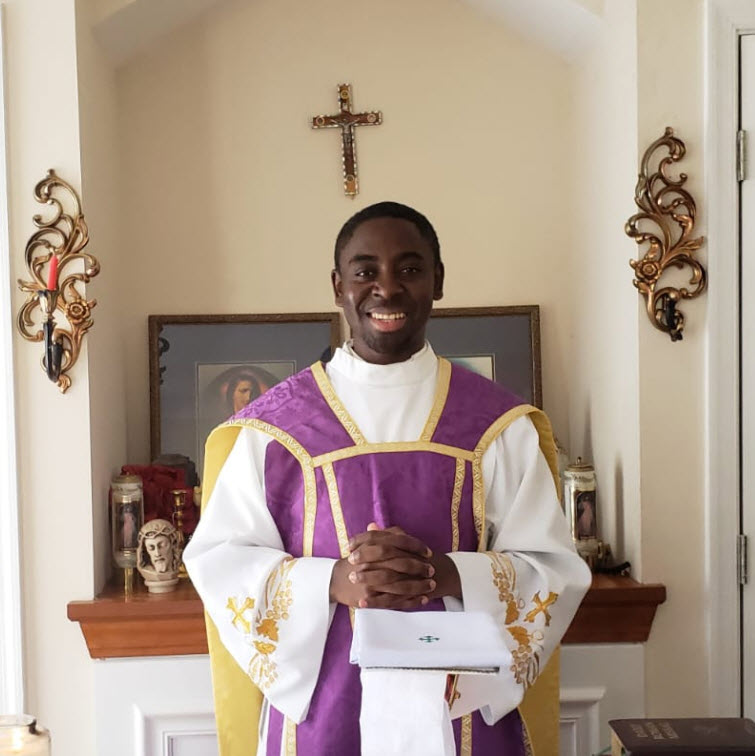
 Fr. Denis Tameh
Few are the men who, by the sheer force of their life and witness, leave an imprint upon an entire generation. Fewer still continue to form hearts and minds long after they are gone. For me, and for many who passed through St Thomas Aquinas Major Seminary, Bambui, one name belongs unmistakably among such men: Blessed Fulton J. Sheen. I was later fortunate enough to study at the Catholic University of America, where Sheen himself had studied and taught. Each time I entered the chapel in Caldwell Hall, I felt as though I had been carried back to the 1920s, when Sheen celebrated Mass and preached in that chapel and walked the corridors of that building. To pray where he had prayed and to walk where he had walked was always a deeply humbling experience.
During my years in the seminary in Cameroon, Sheen was a household name. He was probably the most frequently quoted prelate in the homilies I heard. At table, while we ate in silence, one of the books chosen for our spiritual reading was his beautiful homage to the Blessed Virgin Mary, The World’s First Love. We encountered in him not merely an eloquent American bishop from another age, but a model of the priest we hoped to become: a priest of prayer, intellectual discipline, Eucharistic devotion, Marian love and apostolic zeal; a preacher who understood both the modern world and the means by which that world could be reached with the Gospel.
His beatification on 24 September 2026 therefore has a deeply personal meaning for me. It is the Church’s recognition of a man whose words had already travelled far beyond the television studios and lecture halls of America to shape seminarians and priests in Cameroon. He called himself a vessel of clay, but he was a great vessel through whom God carried the treasure of Christ to millions. He brought many souls, some of them celebrated public figures, to the threshold of faith, yet he never claimed the glory for himself. He knew that the priest may open the door, but Christ alone enters the soul. I shall always remain indebted to his penetrating insights into the spiritual life, especially the life of the priest.
The Secret Behind the Voice
Sheen was a master preacher who penetrated the depths of the human soul. His words carried not merely sound, but substance; not merely eloquence, but grace. Yet the secret of that power was not first found in his magnificent voice, his dramatic gestures or his intellectual brilliance. It was found before the tabernacle. Writing about Sheen’s preaching, the Dominican theologian Fr John Baptist Ku drew a memorable distinction between an orator of the world and an orator of Christ. The former learns how to orate; the latter learns how to orare, to pray. “The first is a dealer in words; the second is a communicant with the Word.” And that is the blessed the Church offers for our guide.
On the day of his ordination, Sheen resolved to spend one continuous hour each day in the presence of the Blessed Sacrament. He kept that resolution throughout his priestly life. In his autobiography, Treasure in Clay, he called the Holy Hour “the hour that makes my day.” It was not a peripheral devotion added to an already busy apostolate; it was the root of his prayer, the source of his strength and the secret of his fruitfulness.
The Lord’s question in Gethsemane, “Could you not watch one hour with me?” became for him a programme of priestly life. In Treasure in Clay, he explains that he kept the Holy Hour so that he might grow into the likeness of Christ. Sitting before the Eucharistic Lord, he wrote, is “like a body exposing itself before the sun to absorb its rays.” Prayer gradually gathers the scattered soul, burns away distraction and teaches the priest to listen. As he memorably put it: “We do not say: ‘Listen, Lord, for Thy servant speaks,’ but ‘Speak, Lord, for Thy servant
heareth.’” Here we discover the difference between the orator of the world and the orator of Christ. The worldly orator learns how to speak; the preacher of Christ must first learn how to pray. Sheen understood that preaching is not the display of a gifted personality. The preacher is the servant and instrument of the Word. The pulpit can bear fruit only when it has first been nourished at the altar. This lesson remains urgent for priests today. We may possess books, technology, eloquence and access to enormous audiences, yet still have little to say if we have not first remained with Christ. Blessed Sheen’s life teaches that the preacher’s first preparation is not before a crowd but before the Eucharist.
The Word Carried Through the Air
Sheen possessed a rare understanding of the media and its power for evangelisation. He began broadcasting on radio in 1928, shortly after joining the faculty of the Catholic University of America. He later became the principal voice of NBC’s The Catholic Hour. In 1952, he entered television with Life Is Worth Living, which eventually reached an audience of millions and made him one of the most recognisable religious figures of his time.
Yet he did not enter the media merely to become famous. He entered it because souls were there. Looking back on the reach of his broadcasts, he wrote in his autobiography, Treasure in Clay, that through radio and television he was able “to address a greater audience in half an hour than Paul in all the years of his missionary life” The comparison was not self-congratulation; it was wonder at what Providence could accomplish through the instruments of a new age.
His description of the two media reveals both his imagination and his theology: “Radio is like the Old Testament,” because wisdom is heard without being seen; television is like the New Testament, because “the wisdom becomes flesh and dwells among us.” He understood that the means of communication could become servants of the Incarnation. The Gospel must never be altered to please the age, but it must be carried into the places where the people of the age are listening.
This remains one of Sheen’s most important lessons for evangelisation today. Were he alive in our time, he would not fear the digital world. He would ask how it might be claimed for Christ. He would understand that social media, podcasts and online platforms are not substitutes for the sacramental life, but they can become roads leading wounded and searching souls towards it.
Sheen’s missionary heart also embraced Africa with a particular affection. As National Director of the Society for the Propagation of the Faith, he begged and raised millions of dollars for the young Churches, schools, hospitals and clinics of mission territories, until he could speak of the consolation of having “a universal mission” and of considering “the world as my parish.” In Treasure in Clay, he records memorable encounters in both Kenya and Uganda. In Kenya, after consecrating Joseph Houlihan as bishop of the newly established Diocese of Eldoret, Sheen travelled with him into the bush. When the new bishop said, “If I had six hundred dollars I would start a clinic tomorrow,” Sheen assured him of the money, and he later rejoiced that the people of that place were being evangelised. In Uganda, he slept on the cement floor of a crowded missionary house and awoke at four in the morning to see a priest departing with a sack upon his back. “Father, where are you going?” Sheen asked. “I don’t know,” the missionary replied. “When will you be back?” “In about six months.” He was going to establish a new mission station. Such encounters reveal why Blessed Sheen’s missionary enthusiasm still speaks so strongly to us in Africa: a blessed is necessarily a missionary, always on mission to bring Christ to others. He could speak to the depths of the soul because he understood the human condition; and that understanding was not merely the fruit of intelligence, but of great prayer. Missionary endeavour without prayer soon becomes activism, but prayer that has truly encountered Christ necessarily becomes mission. Sheen knelt before Christ in the Eucharist and then rose to carry him, through his voice, his sacrifices and the resources he raised, to the ends of the earth.
The Preacher of Paradox
Sheen’s intellectual and rhetorical style was shaped in part by G. K. Chesterton, whose love of paradox enabled him to make familiar truths appear new. Sheen possessed the same gift. He could hold two apparently opposing realities together until their deeper unity became visible.
In Life of Christ, reflecting on the good thief, he writes: “A dying man asked a dying Man for eternal life; a man without possessions asked a poor Man for a Kingdom.” Then comes the unforgettable image of a thief who, at the door of death, asks “to steal Paradise.” Sheen marvels that the first soul to accompany the King of Kings into paradise was not a celebrated saint but a repentant criminal. In a few lines, he gathers together judgment and mercy, poverty and kingship, death and eternal life.
The same gift appears in his preaching on the Cross and Resurrection. Sheen never offered Easter without Good Friday. In Life Is Worth Living, he repeatedly returned to the Christian law that there is no empty tomb without the Cross, no crown of glory without the crown of thorns. Christianity, for him, was not an escape from suffering but the transformation of suffering through union with Christ.
In his recorded catechetical talk New Testament Revelation, he points out the irony surrounding the Resurrection.
Mary Magdalene mistakes the risen Christ for a gardener; the Apostles disbelieve her testimony; the disciples on the road to Emmaus have abandoned hope. Yet the enemies of Christ seem to remember his prediction: they seal the tomb and post guards. With characteristic humour, Sheen exposes the paradox, unbelievers appear more alert to the possibility of the Resurrection than the disciples themselves, a theme he repeated in his great work, Life of Christ.
This was his genius: he spoke at once to the scholar and to the ordinary believer, to the intellect and to the imagination, to the convinced Christian and to the sceptic. He did not dilute theology; he clothed it in images that enabled people to see its truth.
The Eucharist and the Woman He Loved
If the Holy Hour was the centre of Sheen’s priestly life, devotion to the Blessed Virgin Mary was one of its deepest affections. His Marian spirituality was not sentimental and never separated Mary from Christ. In his autobiography, he recalls that, after his baptism, his mother placed him upon the altar of the Blessed Mother and consecrated him to her. At his First Holy Communion, he consciously renewed that dedication. Later, as a bishop, he chose for his motto: Da per Matrem me venire-“Grant that I may come to Thee through the Mother.”
The fruit of that lifelong love is found especially in The World’s First Love: Mary, Mother of God. It is fitting that this was one of the books read to us in the seminary refectory. For Sheen, Mary was not a distraction from Christ but the surest creaturely witness to the Incarnation. He wrote of her with the affection of a son and the precision of a theologian.
Thus, his spiritual life rested upon two inseparable loves: the Eucharistic Lord and the Mother who gave the Word his flesh. The priest who knelt before the Blessed Sacrament also entrusted his vocation to Mary. His prayer was Christocentric, Eucharistic and Marian at once.
The Discipline Behind the Eloquence
Sheen’s preaching was born from prayer, but it was also sustained by immense intellectual labour. He understood that devotion without study can become shallow, just as study without prayer can become sterile.
Cardinal Désiré-Joseph Mercier gave the young Sheen two pieces of advice that remained with him. The first was to remain current: to know what the modern world was thinking, to read its literature, understand its art and listen to its music, while also plunging deeply into St Thomas Aquinas and the wisdom of the ancients. The second was to destroy his lecture notes at the end of each year, lest repetition make his teaching stale. Sheen records this counsel in Treasure in Clay and testifies that he took it seriously.
He warned that preaching and lecturing are impossible without sustained study. “When the intellectual larder is empty,” he wrote, “it is difficult to prepare a homiletic meal.” The image is simple but exact. A preacher cannot nourish others from an empty storehouse. The higher the building, the more material must enter its construction.
Nevertheless, the final preparation of Sheen’s sermons occurred before the Blessed Sacrament. In his autobiography, he says that once the general plan had been formed, he would speak his thoughts quietly to Our Lord. There, in prayer, he discovered which ideas possessed spiritual weight and which were merely clever. This union of study and adoration explains why his preaching was both intellectually serious and spiritually alive.
Sheen therefore remains a model for seminarians and priests: read deeply, think rigorously, understand the world, return constantly to the wisdom of the Church, and then carry everything into prayer. The priest must not choose between the library and the chapel. In Sheen, the two met.
A Preacher Who Sought Souls
Sheen’s apostolate was governed by a simple conviction: God does everything, yet he ordinarily chooses not to act without our cooperation. The preacher must labour with all his strength while remembering that grace alone converts the heart.
He also knew that the preacher must begin where the hearer is. Reflecting in Treasure in Clay on his television ministry, he explained that he would begin with something common to himself and his audience, then move “from the known to the unknown,” and finally towards Christian truth. He saw this method in Christ’s encounter with the Samaritan woman: the Lord began with water and led her gradually to the mystery of living water.
For this reason, Sheen could warn: “Win an argument, and lose a soul.” Truth must be defended, but the person before us must never become merely an opponent to be defeated. The purpose of Christian preaching is not the humiliation of the hearer but his conversion. Sheen’s logic could be relentless, but his pastoral purpose was love.
He once wrote in his autobiography, “A priest never touches reality until he touches a soul”. He believed that on the day of judgment God would ask priests, “Where are your children?” By this he meant the spiritual sons and daughters begotten through preaching, sacrifice and pastoral charity. “God hates spiritual sterility,” he wrote; if the priest wishes to save his own soul, he must spend himself for the salvation of others.
Yet Sheen never confused the instrument with the divine Agent. In recounting the conversions associated with his ministry, he described himself simply as a porter who opens the door. This humility is essential. The priest preaches, teaches, counsels and sacrifices, but Christ converts. The treasure belongs to God; the minister remains clay.
The Priest as Victim
One of Sheen’s most powerful contributions to priestly spirituality was his insistence that priesthood cannot be separated from victimhood. Christ is both Priest and Victim. A priest configured to Christ cannot desire the priesthood of the altar while refusing the sacrifice of the Cross.
This is why Sheen spoke so often about wounds and scars. In his retreat conference Do I Have Any Scars? from The Seven Last Words, he asks whether our service of Christ has cost us anything. He contrasts the wounded Christ with the devil, who has no scars because he has never loved sacrificially. The priest’s hands, life and heart must bear the marks of labour for souls.
That image has remained with me: at judgment the Lord will look at our hands to see whether they have been scarred by the work of winning souls. These need not be visible wounds. They are the marks left by prayer when one is tired, fidelity when one is misunderstood, study when the mind is exhausted, service when no gratitude is returned, and the daily offering of oneself when easier paths are available.
A priest who takes Blessed Fulton Sheen as a model will be guided by one who understood priesthood as a great love story of sacrifice in imitation of the Lamb. He will learn that fruitfulness comes not from popularity alone but from the Cross; not from talent alone but from holiness; not from being admired but from being spent.
“The Ink Used Was Blood”
Sheen’s life and preaching remained firmly centred on Christ. He resisted every attempt to reduce Jesus to a moral teacher or a consoling idea. Christ was the meaning of his life. At the beginning of Treasure in Clay, he makes the striking claim that the true story of his life had already been written centuries before. Its “ink was blood,” its parchment was skin, and its pen was a spear. His autobiography, in other words, could be understood only in the light of Calvary. The story of every priest must likewise become part of the story of Christ crucified.
This is perhaps why Sheen continues to speak so powerfully to priests and seminarians. His brilliance never floated above the Cross. His media success did not detach him from the tabernacle. His learning did not extinguish humility. His love of Mary always led to Christ. His concern for the modern world never became surrender to it.
Now that the Church numbers him among the blessed, I return with gratitude to the man whose books, sermons and example accompanied my own priestly formation. He remains close to the hearts of many Cameroonian seminarians and priests because, through him, we encountered a priesthood at once contemplative and apostolic, intellectually rigorous and pastorally accessible, traditional in truth and creative in method.
As Blessed Fulton Sheen now joins the ranks of the beatified, it is fitting to remember the humorous saying so often associated with him: three things will surprise us in heaven, the absence of some whom we expected to find there, the presence of others whom we never expected to see, and, greatest of all, the astonishing discovery that we ourselves are there. The thought predates Sheen, but its humility, humour and wonder before divine mercy capture something of the man whose preaching taught millions never to presume upon grace and never to despair of it. May he now smile upon that mercy which alone brings any of us home, and may this great preacher, faithful priest and lover of souls intercede especially for the seminarians and priests of Cameroon whom his life, books and priestly witness have helped to form. Blessed Fulton J. Sheen, pray for us.