A Synthesis of the International Conference on “AFRICAE MUNUS – TEN YEARS LATER”, Organized by the Benedict XVI Institute for Africa in Partnership with the Catholic University of Cameroon, (CATUC), Bamenda
Big Mankon, 23th – 25th FEBRUARY 2022
By Fr. Herbert Niba,
Conference Moderator
John Paul II Institute of Theology, Buea.
Introduction
The 23rd of February is celebrated every year as the memorial of St. Polycarp, the martyr and Bishop of Ecclesial unity. In the afternoon of that day, as if in a prolongation of the liturgical celebration of that morning, some 170 persons from all walks of life, united at the St. Joseph Metropolitan Cathedral Hall Big Mankon, under the auspices of the Catholic University of Cameroon, Bamenda, to join the scholars invited by the Benedict Institute for Africa and the Centre for Interdisciplinary Research in Philosophy and Education, to reflect on the person, thought and work of Pope Benedict XVI in relation to the Church in Africa.
This International Conference on Joseph Ratzinger/ Benedict XVI was the second being organized by the Benedict XVI Institute for Africa on Cameroonian soil. The first took place at the Catholic University of Central Africa, Yaoundé from 27th to 29th November 2019, to mark the 10th anniversary of Pope Benedict XVI’s visit to Cameroon. Experts in four ecclesiastical disciplines: namely Theology, Philosophy, Canon Law and Social Teaching of the Church took turns to give the audience at the Franz Kamphaus University Amphitheatre to a review of the reception and implication of the thought of Pope Benedict XVI to the Church in Africa 10 years after his first visit. Two years later, the Benedict XVI Institute for Africa launched an invitation to yet another intellectual banquet. This time the reflection targeted the Post Synodal apostolic Exhortation, Africae Munus, signed by the emeritus pontiff at Ouidah in Benin on the 19th November 2011. The paper below captures the summary of the 3 day exchange by scholars on that document.
DAY ONE: WEDNESDAY 23rd FEBRUARY 2022
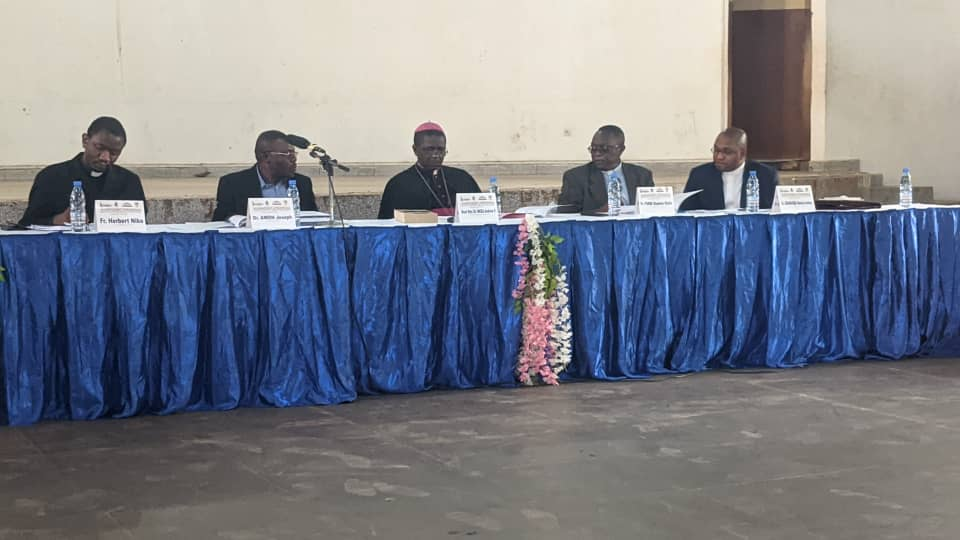
Great expectations filled the hall when the proceedings for the opening ceremony commenced that Wednesday afternoon with an Opening Prayer led by Fr. Herbert Niba at 3:04pm. The prayer was followed by a word of welcome from the representative of the Benedict XVI Institute for Africa, Fr. Maurice Ashley Agbaw-Ebai, in which he situated this conference on Africae Munus in Bamenda as the 4th being organized as a whole by the Institute to explore the thought of Joseph Ratzinger/Benedict XVI, and the first out of three to be held on African soil on the Post Synodal exhortation Africae Munus.
At this point there was a welcome address by the Vice Chancellor of the Catholic University of Cameroon Bamenda, Dr. Joseph Awoh, who saw in the conference a timely roadmap for Cameroon, a nation rocked by all sorts of misunderstandings and conflicts, before which the Church is called to a special heroic witness. He invited the audience to follow the interventions keenly so as to be able to draw at the end of three days, key lessons from Africae Munus for their personal lives and the lives of their communities.
The third introductory remark for the day was the presentation of the structure of the Conference, by Prf Kizito Forbi, SJ, the head of the Scientific Committee that prepared it. He situated Pope Benedict XVI’s Africae Munus, the fruit of the Second Assembly for Africa for the Synod of Bishops at the backdrop of Pope John Paul II’s Ecclesia in Africa, which was the fruit of the first assembly. He described the document as a practical attempt to translate the rich theology of the Church to speak to the plight of Christian, making their joys and hopes, the very joys and hopes of the Church. As a result, to bring out the very best from Africae Munus, the speakers were going to be divided into four panels with the following themes:
1st Panel: Elucidation of the Plight of Africa
2nd Panel: Transformative Theology and the Foundation of Hope for Africa
3rd Panel: Social Questions: Education, Health, Gender
4th Panel: African Christianity.
At 3:23pm, the attention of everyone was now turned to the business of the day, which was the Keynote Lecture for the Conference, delivered by His Grace Andrew Nkea, Metropolitan Archbishop of Bamenda. The prelate prefixed his lecture with some remarks from the just ended February 2022 Assembly of the Conference of Bishops of the Bamenda Ecclesiastical Province (BAPEC). It gave joy to the audience to hear that the Bishops of BAPEC had given not just their blessing, but also were enthusiastic for the establishment of a Benedict XVI Institute for Africa in our local Church. Whereas this initiative had as primary aim to further the teachings and legacy of the Pope within the Church in Africa, the institute, by its attachment to the Catholic University of Cameroon, Bamenda, was going to increase the visibility of our Provincial University in international circles, and also provide a recognized forum for constant scholarly publications by lecturers and researchers in our provincial institutes and houses of formation. He therefore challenged the scholars who had been convened to form an Association of Theologians and Philosophers from the Church Province of Bamenda.
After these preliminary remarks, the Chief Shepherd of Bamenda, in his own right a specialist in Ecclesiastical Law, nourished the audience with an Inaugural lecture entitled: “The Theology of Law of Joseph Ratzinger/Benedict XVI: Pastoral Perspectives for the Church in Africa in the Light of Africae Munus, Ten Years Later”. The theme of the lecture was introduced by the question: “What constitutes a just social order, and how can a right understanding of law and justice help to bring it about”. After a sound survey on the meanings of the terms “law” and “justice” from ancient Roman and scholastic traditions, the Archbishop picked on Benedict XVI’s address to the German parliament, where the Bavarian Theologian had settled on the thesis that Natural law, which is the representation of the eternal law of God in the realm of creatures, is the rightful basis of positive law. All worldly power, even legitimate democratic power, if it has to avoid being misused has to recognize the existence of a higher truth, and a realm of law beyond human powers. The Archbishop concluded by calling on Theologians, Jurists and Political Philosophers to wake up from sleep and so be the sentinels or watchmen of a society that is at the mercy of constant abuse of power and arbitrariness of civil authorities. The 36 minutes address was received with a thunderous applause. At the end of it, the participants went for a family photo in front of the St. Joseph Metropolitan Cathedral, Bamenda, after which they retired for the day.
DAY TWO: THURSDAY, 24 FEBRUARY 2022
The second day of the Conference featured the presentation of papers by the scholars and researchers who responded to the call for papers. Two panels animated this day, the first being the “The Problematization of the African Reality”, held in the morning and moderated by Dr. Joseph Awoh, and the second, “Transformative Theological Praxis”, held in the afternoon and moderated by Dr. Giles Ngwa Forteh.
The First conference, delivered by Fr. Jean Paul Tagheu was entitled “The Christian in the City: Political Commitment according to Africae Munus”. The guiding thread of the reflection was inspired by these questions: Can the Christian life and the political life in the city be reconciled? To what extent can a Christian be involved in political affairs? The author asserted that there is continuity between civic virtue required for life in the polis, and Christian virtue. Being a good Christian can make one a good citizen, and vice versa. However, he note that since justice in the Church is more than just doing right or one’s duty, he called for a “theology of the polis”, where citizenship is transformed by a “justice of love” as advocated by Africae Munus no. 25. The paper was critically reviewed by Prf. Stephen Kizito Forbi, SJ.
The second paper, given by Dr. Formutar Stanislas, was entitled “Africa at the Crossroads of Culture Shock and Adaptation: An Evolutionary Perspective”. The author started off with an observation of the prevalent trend in African culture, politics and civil society that is working hard to shake off vestiges of Western culture and imperialism from the daily life. By borrowing the concept of adaptation from evolutionary biology and linking it to the practice of inculturation of the Gospel and the evangelization of cultures, discussed in Africae munus no 26-27, he defended the idea that no culture is static, but cultures grow by mutual influencing. Any culture which does not open itself to positive values or any religion which does not incarnate itself in local cultures is doomed to become irrelevant or even grow extinct. The paper was critically assessed by Dr. Maurice Agbaw-Ebai.
The third presentation of the day was given by Dr. Valentine Ngalim, and had as title: “The Task of the Church in the Process of Peace and Reconciliation: Perspectives from Cameroon”. The talk was inspired by the frequent rebuff addressed by Cameroonian politicians to prelates and clergy to stay away from involvement in politics. The author put this side by side with the assertion from Africae Munus no. 23, that Politics is out of the direct competence of the Church. He sought to establish, in a Cameroonian context, the proper competence and limits of the Church’s involvement in the political life of a country. He postulated many indices of the Church’s transformative impact in political life, such as through education in virtue, the promotion of the sense of the common good, consistent preaching on social justice, and teaching of the lives of saints as heroes of the life of virtue. On the other hand, he saw dangers and instances of anti-witnessing in practices like undue proximity with and involvement with party politics, the acceptance of political nominations, complicity in perpetrating electoral fraud, as well as hasty endorsements and discordant pronouncements after elections. In synthesis he called for frank cooperation and dialogue between the Church and Civil Society, to ensure healthy civic life in the nation. The paper was reviewed by Mr Maimo Bello Nicodemus.
At 11:15am, there was a question and answer session coordinated by Dr. Nelson Shang. This brought about a lively discussion on the clash between Christianity and African Traditional Religion, as brought about in Chinua Achebe’s Things Fall Apart. The necessity to distinguish between Politics and Theology and the need to protect the transcendent nature of the object of Theology was reiterated. After the question and answer session the audience broke off for a one hour lunch break.
The afternoon session started at 1:05pm, moderated by Dr. Giles Ngwa. The first talk, given by Dr. Nelson Shang focused on “Africae Munus on Catholic Education as Precious Resource for the Transmission of African Values: Creating the bonds of Peace and Harmony in Society”. The author saw in education the enterprise of receiving values, modifying and transmitting them to later generations. Education for him was a moral obligation for the society and a right for every child, for education makes available to future generations the knowledge, skills and competencies of past and present generations. For the author, Catholic Education could help uplift and transmit key values present in African societies, like the sense of the sacred, the sense of community (ubuntu), respect for the sanctity of life and respect for elders. These are very important in a context where secular society is brandishing counter values like tolerance and relativism. The paper was reviewed by Dr. Valentine Ngalim
The 2nd Conference by Fr. Denis Tameh was entitled “An examination of Africae Munus in the light of the triple munera of Can 204”. The author noted that a distinctive aspect of Africae Munus is that the target audience is not just Roman Catholics but all Christ’s faithful, a terminology which comprises all those who are validly baptized, whether or not they are in communion with the Church. The author inferred from the universal outreach of this document a moral imperative for every member of Christ’s faithful to exercise the rights that come with their baptism. This also involves assuming the responsibilities that come with the threefold dignity of office of king, prophet and priest. As far as the rights and obligations that come from baptism are concerned, there is a fundamental equality between the ordained and non-ordained. By virtue of their immersion in the civil society, the laity have wide avenues of impact, and an irreplaceable role in fostering reconciliation, justice and peace. It doing so he showed that the law, far from being an instrument of oppression, is an application of Theology. The paper was reviewed by Dr. Joseph Clifford Ndi.
The third conference for the afternoon, presented by Dr. Maurice Agbaw-Ebai was entitled “Scripture and Eucharist in the Theology of Joseph Ratzinger/Benedict XVI”. The author situated the context of his paper, first in Joseph Ratzinger’s adherence in “ressourcement theology”, which was characterized by a return to the Patristic sources, and also Ratzinger’s constant engagement with Philosophers and Theologians from both Catholic and protestant backgrounds. From this analysis there emerged key threads in Ratzinger’s Theology of the Eucharist, namely thanksgiving, transformation, immolation and the idea of “gift”. A key point noted was the fact that Ratzinger (a position that became that of Vatican II’s conciliar document, Dei Verbum), Tradition and Scripture both transmit Revelation, they are not revelation taken singly. The respondent for this conference was Dr. Charles Sengka.
The three conferences were followed by a question and answer session moderated by Fr. Herbert Niba. The afternoon session closed at 4:15pm and the conference participants retired for the day.
DAY THREE: FRIDAY 25 FEBRUARY 2022
The third day consisted in two panels, the first panel targeted Social questions raised by Africae Munus, and it was moderated by Dr. Peter Takov. The second, targeted African Christianity, and was moderated by Dr. Maurice Abgaw Ebai.
The first Conference for the morning session, presented by Fr. Jude Basebang, was captioned “Preaching Reconciliation in a Divided Zone in the light of Africae Munus”. The author presented Cameroon as a land of a great paradox. On the one hand, it is a land richly blessed with natural resources, talents and a land of promise. At the same time, there is endemic poverty, stagnation, corruption and war. In many ways, the Church ends up as a mirror image of the very society for which it ought to be a conscience. For many in civil society, as in the Church, the blood of the tribe is thicker than the waters of baptism. Yet, this same Church has many platforms available to her to preach reconciliation, justice and peace, such as the family, the school, small Christian community, and the world of social communications. Beyond the political, tribal, cultural affinities that have become so deeply rooted and divisive, there is a need to forge a new African identity based on our common sonship in God, motivated by the need to practice reconciliation, justice and peace. The reality of marriages across tribal boundaries constitutes a big evangelical opportunity to be utilized by the Church. This paper was reviewed by Dr. Joseph Awoh.
The second Conference was presented by Dr. Giles Ngwa Forteh, with the caption “Healthcare in the light of Africae Munus: From a merely biomedical to a holistic paradigm of Healthcare”. The main argument of the paper consisted in three assertions. First, Pastoral care of the sick, which is an extension of the saving mission of Christ targets the whole person: body, soul and spirit. Secondly, the reality of Africa shows an increasing prevalence of chronic diseases, which not only harm the patients physically, but cripple them psychologically, ostracize them socially, and depress them spiritually. Finally, the author said for healthcare to be efficient, it must be holistic, and in line with Benedict XVI’s recommendation in Africae Munus no. 140, it must bring Jesus’ compassionate love to those who suffer, by effective interpersonal communication, social support, confidentiality and spiritual assistance. This conference paper was reviewed by Fr. Herbert Niba.
The third Conference, presented by Prf Kizito Forbi, SJ, was entitled “Women’s Participation in Peacebuilding and Reconciliation: Africae Munus in a Feminine Key”. The author began with a survey of the involvement of women in peace building in recent post-war conflict resolutions initiatives in Africa. The result showed their involvement was very minimal. Using Africae Munus no. 58, where the Pope called women to stand up when peace is under threat, and when justice is flouted, he sought to show how despite the violence perpetrated against women, they could take their role in peace building. Doing this involves going beyond the mere recognition of the dignity of women, to providing adequate knowledge, and opportunities to help women bring along their “feminine gift” to society, since they are understood and respected in Africa already as defenders and protectors of life.
This paper was critically reviewed by Dr. Tah Bongka Vivian, whose presence on the panel was highly saluted, as the lone feminine respondent of the conference. Her input greatly inspired the audience, especially the women present to take up the challenge to permeate their families and communities with the lessons and exchanges of the conference, so that more and more women will be interested to take front roles in initiatives that foster the education and advancement of women. In her own words, “women should not only beautify their bodies, but also their brains”.
The afternoon session started at 1:05pm. It targeted “African Christianity” and was moderated by Dr. Maurice Agbaw-Ebai. The first conference, entitled “The African Concept of Person: A source of Spiritual Renewal” was jointly presented by Dr. Peter Takov and Mr. Maimo Nicodemus. The authors situated an African Concept of the Person by reference to two twin concepts, “ubuntu” and “ujama”. The first concept, “Ubuntu”, promoted by Desmond Tutu and J.S. Mbiti had at its core, sharing, caring and living in harmony. The second concept, “Ujama”, refers to mutual cooperation. At the basis of both realities are the philosophical concepts of alterity and participation. Ubuntu, for the authors, responds the call of Africae Munus, that Africa should go back to its sources for the values that it has to teach to world. However, the authors also note that prevalent threats to this concept, as manifested by individualism, nepotism, favouritism that have rocked the political landscape and which is also making inroads into the Church. In conclusion, the author provocatively asserted that it would seem that the African concept of “ubuntu” is in the mortuary, and risks burial. However, it can be revived through the honest attempt by Church members and leaders alike to put the love of the human person and the common good at the centre of every endeavour. The paper was reviewed by Prf. Kizito Forbi.
The second presentation from Dr. Mathew Ngoran, entitled “The Voice of the Voiceless: The Task of Church Leadership under oppressive African Regimes”.
The author commenced his presentation by situating the “prophetic voice” of the Church from its biblical roots, which consists in speaking on behalf of God, on behalf of the voiceless, and being a messenger of the truth: “speak for those who cannot speak, for all the rights of the destitute” (Prvb 31:8-9). In line with Africae Munus no. 22, the author affirmed that the duty to preach the truth is an indispensible and alienable duty which the church can never renounce. To fail to proclaim the truth in the face of injustice is to promote the economy of confusion and hypocrisy. Using examples from South Africa’s Desmond Tutu and South America’s Oscar Romero, he defended the thesis that to be neutral in the face of injustice, is to have taken the side of the oppressor. He outlined some factors which could silence the prophetic voice of the Church, such as gifts of compromises, love of money with strings attached, internal injustices within the church and fear of the oppressor. He concluded by saying when leaders of the Church are not credible, the future of the Church is uncertain. The paper was reviewed by Dr. Nelson Shang.
The interventions gave way for a question and answer session moderated by Dr. Valentine Ngalim that lasted till 3pm. The participants then took a short break before the closing ceremony.
Conclusion
The Closing ceremony of the Conference was marked by some three votes of thanks. In the first place, Fr. Kizito Forbi on behalf of the Scientific Committee that prepared the Conference, thanked the panelists for their time, and the quality of research put into the writing of the papers. He also thanked the Rector of St. Thomas Aquinas Major Seminary and the Superiors of some the Religious institutes around Bamenda who had made it possible for their candidates to partake in the conference.
The representative of the Benedict XVI Institute for Africa, Fr. Maurice Agbaw Ebai, thanked the members of the Scientific Committee for the ground work that made the Conference possible, and also rendered gratitude to the Vice Chancellor of the Catholic University of Cameroon, Bamenda and his team, for the warm welcome. He announced that two other Conferences on Africae Munus are planned already to take place in Nairobi, Kenya in August and also Johanesburg, South Africa in the month of November 2022. Those who could make it were encouraged to participate.
The last word came from the Archbishop of Bamenda, who thanked all who had made it a rendezvous in CATUC, the “City of Wisdom” for the three intense days of learning and exchange. He affirmed that the Benedict XVI Institute for Africa was a very welcome gift for the Church in the Bamenda Ecclesiastical Province, and he reiterated his challenge to the scholars in the hall to work hard to make theological reflection in our Church to be alive and active. In his closing prayer, he invoked the blessing of God on everyone gathered for the conference, and also upon Pope Emeritus Benedict XVI, at the approach of his 95th birthday come April 16, 2022.
And so it came to pass that the International Conference on Africae Munus that started on Wednesday 23rd February came to a close on Friday 25th February 2022. As the participants continued the spirit of camaraderie one could sense the beginning of the fulfillment of the dream of Pope Benedict XVI who had said in Yaoundé:
Perhaps this century will permit, by God’s grace, the rebirth on your continent, albeit surely in a new and different form, of the prestigious School of Alexandria. Why should we not hope that it could furnish today’s Africans and the Universal Church with great theologians and spiritual masters who could contribute to the sanctification of the inhabitants of this continent and of the whole Church?[1]
Perhaps that dream is already coming true. If it does, it will prove that Benedict XVI was right on yet another observation he made about the Church in Africa: “a precious treasure is to be found in the soul of Africa, where I perceive a “spiritual ‘lung’ for a humanity that appears to be in a crisis of faith and hope. However, if it is to stand erect with dignity, Africa needs to hear the voice of Christ who today proclaims the love of neighbour, love even of one’s enemies, to the point of laying down one’s life: the voice of Christ who prays today for the unity and communion of all people in God (Africae Munus, no 13). Ecclesia in Africa, the time is now!
Delivered as prepared on by 25th February 2022, by
Fr. Herbert Niba
C/O John Paul II Institute of Theology, Buea
Secretary of the Conference
Friday, 25th February 2022
[1] Benedict XVI, Address to Members of the Special Council for Africa of the Synod of Bishops (Yaounde, 19 March 2009): AAS 101 (2009), 312. See also Africae Munus, no. 137.