Reposted with permission from lambomvuvuzela.com
MINNEAPOLIS/ROCHESTER Minn. — In 1984, then Cardinal Joseph Ratzinger is reported to have visited Minnesota where he celebrated the anniversary of St John Mary Vianney seminary and dedicated its new building while the University of St. Thomas awarded him an honorary Doctor of Humane Letters. He seemed to have planted a seed there which is now bearing fruits as four decades later, the twin cities of Minnesota, hosted twin conferences on the rich intellectual legacy of Cardinal Ratzinger who became Pope Benedict XVI and died at age 95 in 2022.
Minnesota Emerges as a Hub for Ratzinger Scholarship
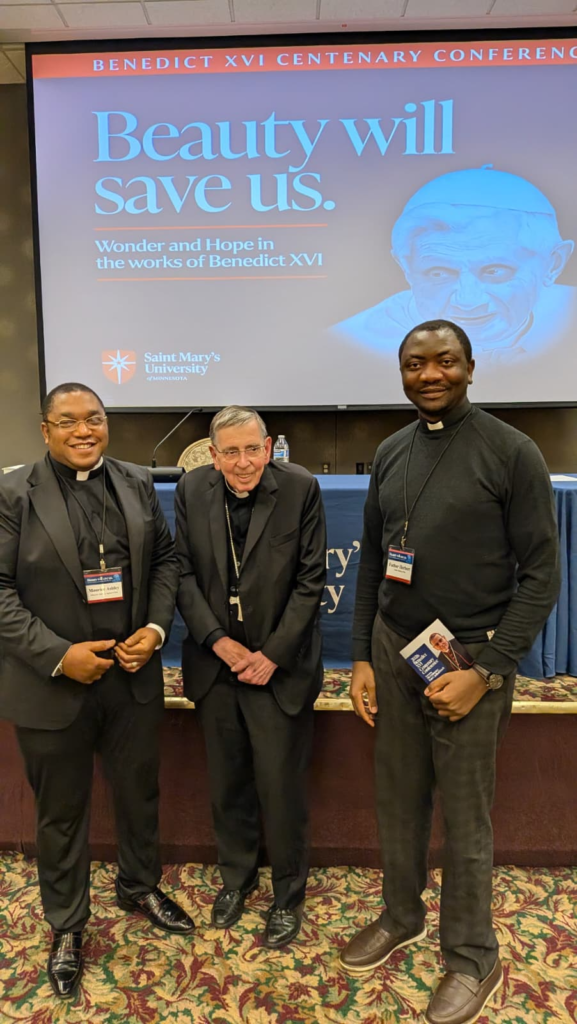
Minnesota is shaping up to be the intellectual center of the thoughts and teachings of Ratzinger. Ahead of the celebration of the centennial of the birth of Joseph Ratzinger in April 2027, scholars from around the world gathered first at the St Mary’s University (future home of a Benedict XVI Institute) whose President Very Rev Fr James Burns, IVD, Ph.D. is a prominent promoter of the integration of Ratzinger’s theological heritage into Catholic higher Ed; they reflected on the theme: “Beauty Will Save Us: Wonder and Hope in the Works of Benedict XVI;” the second, organized by Word on Fire, whose founder Bishop Barron proclaimed that, “few theologians have shaped my thinking more than Pope Benedict XVI,” held in Rochester from Wednesday Nov 4 through Friday Nov 6 on the theme: Ratzinger and his sources. St Mary’s University, it is worth pointing out is the only university in the United States of America with an established Endowed Chair on Benedict XVI currently held since 2024 by Prof Pierluca Azzaro, Executive Secretary of the Ratzinger/Benedict XVI Vatican Foundation.
Beauty, Hope, and the “Mozart of Theology”
At Saint Mary’s University, the two days event began on All Souls Day with a mass in honor of Pope Benedict XVI at the iconic St Agnes Church in Minneapolis. It had an abiding “Germanesque” flavor. St Agnes Church is reputed for its Baroque architecture and historically served Germans and Austrians and today is famous for its celebration of traditional Catholic liturgy in Latin. The mass featured the famous “German” music prodigy Mozart’s Requiem, his last composition
This mass celebrated by Cardinal Koch served as a foretaste of the conference not just because it celebrated the memory and honor of Ratzinger but even more so it highlighted what the late Archbishop of Cologne Joachim Cardinal Meisner at the 80th birthday of Pope Benedict referred to him as the “Mozart of Theology.”
“His theology is not only true and good, it is also beautiful, said Meisner. “His words sound like music in the ears and hearts of people. He manages masterfully to transform the notes of the Gospel into thrilling music.”
Cardinal Ratzinger loved music in general and under the inspiration of Hans Urs von Balthasar, he “viewed Mozart’s music not as mere entertainment, but as objective truth and beauty that bridges human existence with the divine.” Mozart was Ratzinger’s best composer. For the “Mozart of Theology” whose intellectual beauty was the focus of the conference, Mozart’s Requiem was an appropriate selection.
On Tuesday, Nov 3, the day began with another mass celebrated at St Paul’s cathedral by the local ordinary, Archbishop Hebda.
There could be no better person to deliver the keynote for this conference than Kurt Cardinal Koch, Prefect of the Dicastery for promoting Christian Unity, and close ally of Pope Benedict. In 2010 Pope Benedict XVI appointed him to be the main speaker at the annual gathering of Ratzinger’s Circle of alumni which he has led since then. He spoke on the theme “Rebuilding a Culture of Hope.” Drawing from Pope Benedict’s 2007 encyclical letter Spe Salvi – Hope saves, he demonstrated that beauty and hope are deeply connected as reflections of God’s nature. Hope is the antidote to modern despair and the illusion of secular progress.
The 2026 winner of the Ratzinger prize, Notre Dame Professor, John Cavadini addressed the conference on “The Meaning and importance of Joseph Ratzinger’s Theology for me and for the Church and Today world.”
In a panel of elite Ratzinger “MVPs” to borrow a sports terminology, Cardinal Koch interacted with the 2020 recipient of the Ratzinger Prize, Prof Tracey Rowland and the 2026 winner of the same prize, Prof John Cavadini.
Exploring Ratzinger’s Architecture of Truth
One of the speakers at this conference, Rev Prof Maurice Agbaw-Ebai delivered a lecture on “The Drama of Truth: Theology, Philosophy, and the Ressourcement Renewal.”
Taking off from the conference concept note that Benedict believed beauty is more than mere admiration but a path towards the truth, goodness and hope, Prof Ebai explored and delineated Ratzinger’s journey with and to the truth. This is summed up in his episcopal motto from 3 John 1:8, Cooperatores Veritatis – Co-workers of the Truth.
To Ratzinger truth and its centrality grew from two foundational horizons namely “meta-epistemic” and Christological, said Fr Ebai. This is beautifully explained thus: the rational grounds for knowing the truth is given the most firm foundation by the Revelation of God in history in the person of Jesus Christ of Nazareth, the Way, the Truth and the Life.
According to Fr Ebai, one of Ratzinger’s key sources is the fathers of the Church Fathers, especially St.Augustine and his polemic against error. This is evident in Ratzinger’s doctoral thesis “People and the House of God in Augustine’s Doctrine on the Church,” in which he states the truth refutes and clarifies against error, Faith shapes understanding and love builds unity. The other source lies in his engagement with German idealism especially as espoused by Kant and Nietzsche.
Ratzinger’s architecture of truth tackles three fundamental questions: Can we know the truth? What is the nature of the truth that can be known? Why must we defend the truth?
He urged the participants “to safeguard the sensibility to the truth: to invite reason to set out ever new in search of what is true and good, in search of God; to urge reason to keep the sensibility to the truth alive.
Word on Fire’s New Ressourcement Conference: Ratzinger and His Sources
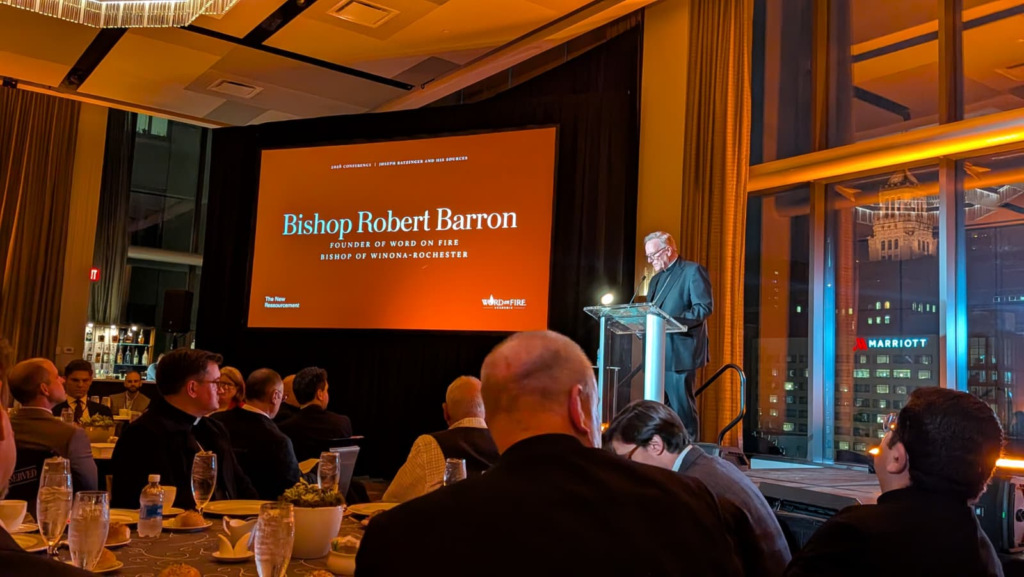
From Minneapolis, participants drove South East to Rochester, where the Word on Fire, the global Catholic media apostolate, hosted its fourth annual New Ressourcement conference. Its focus: Ratzinger and his sources.
According to the organizers the conference sought “to explore the intellectual world of Joseph Ratzinger / Benedict XVI and the principal figures and texts that shaped his theological vision and papacy.”
To kick off the evening, Bishop Barron revisited a January 2004 debate between Cardinal Ratzinger and Habermas on “the pre-political foundations of the distinctively modern political arrangements.” The debate hinged on the question: Does the free secularized state exist on the basis of normative presuppositions that itself cannot guarantee.
The appeal of this debate in Bishop Barron’s estimation is the fact that “It gives access to what is arguably the pivotal theme to all of Ratzinger’s intellectual work namely the nature and range of logos”
Dissatisfied with Ratzinger’s response to Habermas which Bishop Barron found too brief and deferential he attempts “A far more adequate response…gleaned from an exploration of the variety of Ratzinger’s writings over the decades. The most important of these are Ratzinger’s Introduction to Christianity and the Regensburg address in which Ratzinger “Lays out a genealogy of ideas which permits us to appreciate how we got to the point where leading European intellectuals such as Habermas can propose a purely procedural account of the truth that effectively brackets any consideration of Metaphysics.” Ratzinger makes the case for a logos-centered Metaphysics and Epistemology. Hence the title of his lecture: “The Necessity of a Metaphysics of Logos in the Determination of Justice: An Examination of the Ratzinger-Habermas Debate.”
African Catholicism as a “Spiritual Lung” for the Global Church
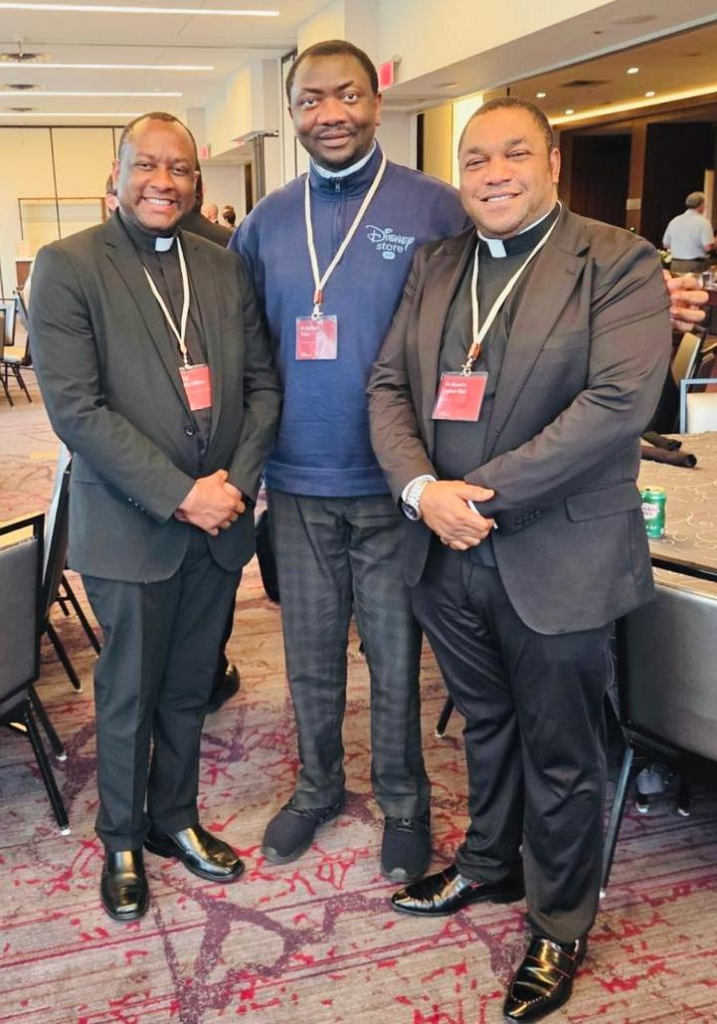
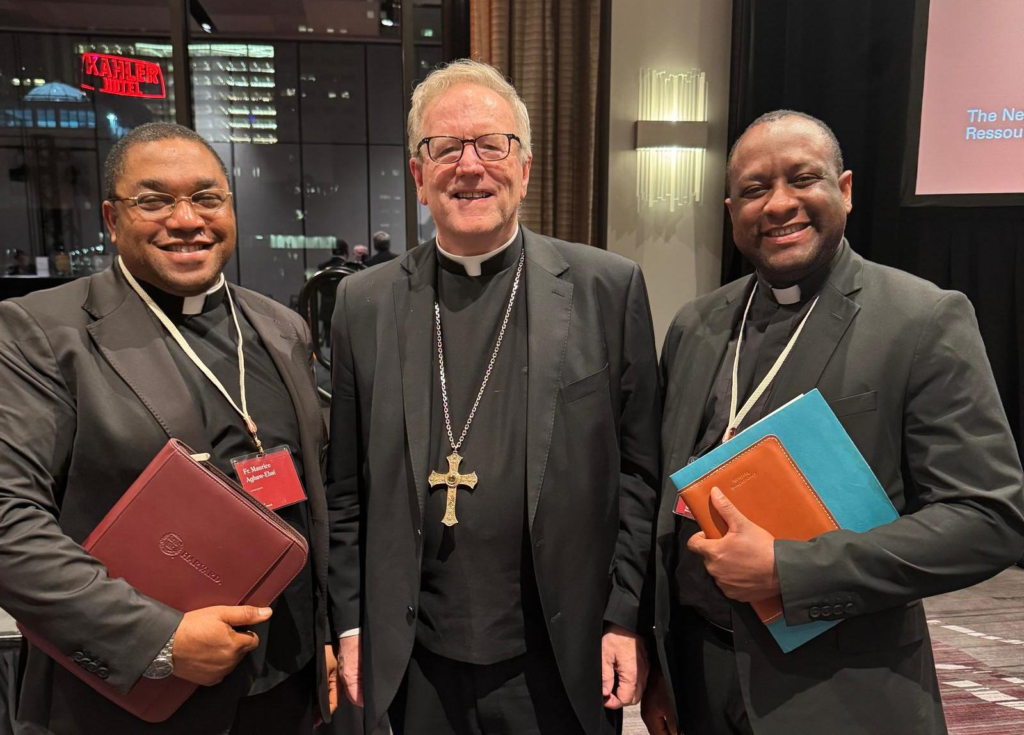
Among the over one hundred scholars at this conference were three Cameroonian priests who took an active part in the deliberations with Rev Prof Maurice Ebai presenting at both conferences and Rev Dr Tegha and Rev Fr Herbert Niba presenting at the second.
Rev Prof Maurice Ebai, the brain behind the Benedict XVI Institute Africa at the Catholic University of Cameroon, Bamenda, was one of eight speakers of the four plenary sessions over the course of the conference. During his presentation on “African Catholicism: A Vital Spiritual Lung for Global Ecclesial Renewal in Benedict XVI’s Africae Munus,” Prof Ebai focused on the reasons for Pope Benedict’s hope in the African Church. He broached the question of what Africa can provide the global Church on its journey through ongoing renewal.
Drawing from Africae Munus, the post apostolic exhortation Pope Benedict XVI promulgated in 2007, Fr Ebai noted that Benedict identified the continent of Africa as a “spiritual lung for a humanity that appears to be in a crisis of faith and hope” presenting “Africa as a source of spiritual renewal whose gifts bear significance beyond the continent itself.” He outlined seven areas identifying these gifts namely reconciliation and peacebuilding, spiritual vitality, authentic social transformation, true liberation, inculturation and interreligious dialogue and witness to a more transparent and accountable exercise of leadership. He was quick to precise that these are both gifts the growing Church in Africa brings to the universal Church as well as tasks for her to build.
“The presence of African scholars at this conference is a big impetus” said Fr Niba “to say Africa is not only a receiving Church in terms of the faith but has a witness that it can give out and also contribute in the furtherance of thought.”
Rev. Dr. Tegha A. Nji (2024 recipient of an award of Excellence and Promise as a Young Ratzinger Scholar, by the Vatican Ratzinger Foundation), who is currently teaching at the Augustine institute addressed Ratzinger’s skilful harmonization of two strands of Christocentrism in his writings — that of St. Augustine and St. Bonaventure, two of his major theological sources.
While for St. Augustine Christ is the end (apex) of time and history, for St. Bonaventure he is the center (centrum). These two strands run together, through Ratzinger’s works. For example, following Bonaventure, explained Fr Tegha Ratzinger understands creation (time and history) within the dynamics of exitus (from God) and redditus (back to God), always through Christ, of whom sacred scripture declares, “through Him and for Him all things were created” (cf. Col 1:15-18 & Jn. 1:3). Christ is the axis on which time and history revolve. And like Augustine, Ratzinger likewise emphasizes how Christ is the end of history, or in Pauline categories, “the Last Adam,” the goal of man and history.
Of the many lessons Fr Tegha took home from this conference, four stood out of particular importance.
First, Cardinal Kurt Koch’s personal stories of his encounters with Cardinal Ratzinger/Pope Benedict XVI which pulled open the curtains thus providing testimony of key aspects of the life of Ratzinger. He revealed for example that contrary to what many imagined, Ratzinger believed in the centrality of ecumenism and held the unity of the Church dear to his heart. He personally brought Cardinal Koch to Rome to lead this initiative.
Next, was Christopher Ruddy’s interesting characterization of liberalism as both a foil and spur for Ratzinger’s theological enterprise.
Third, from Fr. Milan Sturgis presentation, what stood out was Ratzinger’s response to the twin errors of modernity, which, on the one hand, is the self receding to itself in individualism and, on the other hand, is the exaltation of the self as the measurement of truth. Both errors espouse a vacuous sense of freedom without foundation. Contrarily, Ratzinger grounds the human being’s dignity and freedom in and through his relationship with God.
Lastly, 2024 Ratzinger Prize winner Prof Cyril O’Regan’s categorization of the threefold modes of Ratzinger’s interaction with his sources, imitation (substantive repetition), emulation (appropriation not just of substantive contents, but of structure and style), and figuration (being shaped and formed by them in the most fundamental and eminent sense possible. These different modes are noticeable with the different sources upon which Ratzinger is drawing, from Augustine to Bonaventure, De Lubac, Newman, to Guardini.
Overcoming Stereotypes and the “Dictatorship of Relativism”
Rev. Fr. Herbert Niba, a doctoral student at the John Paul II Institute in Washington, D.C., in his paper “Change of Substance, Symbol or both: Ratzinger’s Non-Thomistic Defence of Transubstantiation“, applied Ratzinger’s thought to declining Catholic belief in the Real Presence of the Eucharist. Addressing critiques that dismiss transubstantiation as outdated medieval philosophy, Niba showed how Ratzinger’s account of Transubstantiation is at the same time theologically robust and adaptable to a simplified Catechesis for Eucharistic renewal. While sharing Aquinas’ conviction that no change takes place at the physical or chemical level to the bread and wine after consecration, Ratzinger builds upon Aquinas’ relational understanding of reality, to say bread and wine lose their creaturely independence and exist “no longer for themselves but for God”. They are truly “trans-substantiated”, that is, changed in their most personal and intimate level from being merely things in their own right, to being “pure signs” of God’s presence.
In this way, as Fr Niba suggests, Ratzinger combines the two accounts of change of substance and change of symbol, showing his double indebtedness to Aquinas and also Teihard de Chardin, whose teachings are ingeniously used to link Eucharistic transformation to God’s broader plan for creation and the Resurrection. This understood, Fr. Niba cautioned against caricaturing Ratzinger’s relationship with St. Thomas Aquinas. While Ratzinger once remarked in his memoirs that he struggled with the dry neo-scholastic presentations of Thomism, his deep appreciation for the Angelic doctor was never compromised by his love for his mentor Augustine, nor by his cautious appropriation of some ideas of the Jesuit paleontologist Pierre Teilhard de Chardin—whose vision of cosmic redemption in Christ—has made its way to papal encyclicals of the 20th century.
A Lasting Intellectual “Afterlife”
Summing up the gatherings, Fr. Niba described the conferences as an academic Areopagus—a vibrant wellspring for drawing from the faith and intellect of Joseph Ratzinger. This was especially underscored by Prof. Tracey Rowland’s keynote that traced Ratzinger’s theological formation to an earlier “German ressourcement” that pushed back against the intellectual currents of Luther, Kant, Hegel, and Nietzsche—currents that laid the groundwork for what Benedict XVI famously termed the “dictatorship of relativism.”
Reflecting on social media afterward, Bishop Barron affirmed that “academics from around the world gathered to attest that the life of the mind is essential to the evangelization of the culture.”
Ahead of the conference, David Gibson, Director of Fordham’s Center on Religion and Culture wrote: “Interesting that Ratzinger/Benedict seems to be having a more vibrant ‘afterlife’ than St. John Paul (the Great). I suspect R’s influence will be much greater.”
A closing highlight of the conference included the presentation of two key publications. Fr. Joseph Fessio, former student of Ratzinger, presented the Joseph Ratzinger Compendium, a comprehensive reference work by 72 international scholars covering the major themes of Joseph Ratzinger’s life and thought, published by Ignatius Press. Next was the compiled edition of Ratzinger’s 3-Volume work, ‘Jesus of Nazareth’, presented by Brandon Vogt, the Publishing Director of Word on Fire Academic, the institution that henceforth holds the Copyrights to the English Editions of all works of Joseph Ratzinger/Benedict XVI. Prof Tracey Rowland and Rev Prof Maurice Agbaw-Ebai will guest-edit a special edition of The New Ressourcement to be published 2027 in honor of the centenary of Ratzinger’s birth.
As the participants relished these two milestones, many of them echoed Cardinal Koch’s earlier sentiment during the conference Q & A: in his estimation, Joseph Ratzinger – Pope Benedict is a Doctor of the Church in the making, though a formal declaration remains the prerogative of the Pope.